01
Ground-source heat pumps
The first architecture under active development.
First application / in development
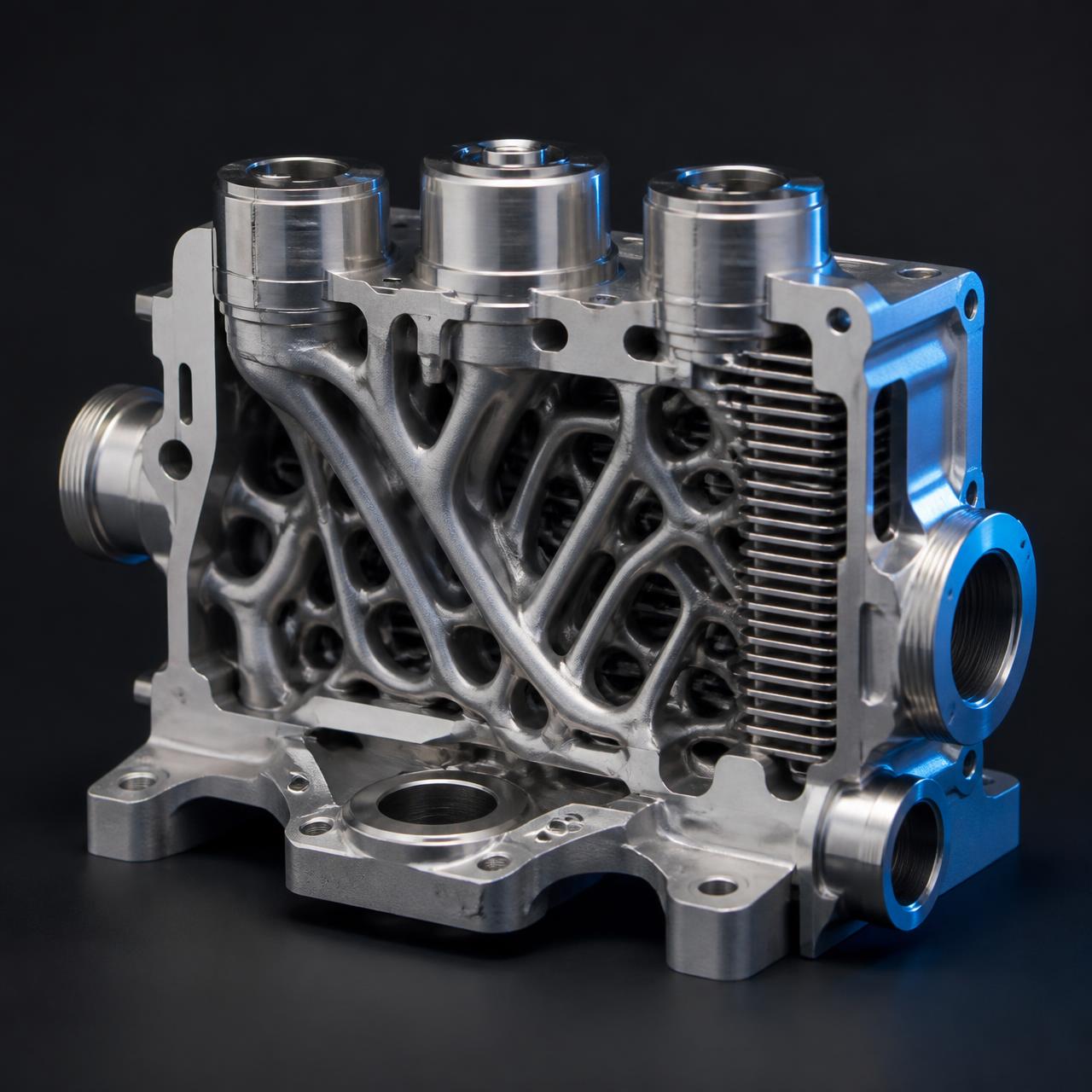
Computationally engineered thermal machines
MORLYT
The problem
Today’s heat pumps are highly efficient machines.
But their underlying manufacturing architecture is still based on assembling dozens of separately designed components.
What if we stop optimising the components — and start computationally designing the complete thermal system?
Conventional assembly architecture
Compressor
Heat exchangers
Pipes
Bends
Connections
Manifolds
Sensors
Valves
Pumps
Mounting components
The hypothesis
If true, the implications extend far beyond component count.
Fewer parts
Less material
Less assembly
Fewer failure points
Engineering hypotheses under test — not demonstrated outcomes.
Architecture study
Conventional architecture
MORLYT architecture
Concept architecture — exterior engineering study
Computationally engineered thermofluidic core
Integrate functions where integration creates measurable technical and economic value.
Development metrics
Measured against a commercially available reference heat pump.
Fewer thermal & hydraulic parts
Fewer connections
Less internal pipework
Less assembly time
Lower thermofluidic material use
Lower refrigerant charge
Smaller machine volume
Target reduction in series production cost
Efficiency target
≥ Reference machine
These are MORLYT development targets, not demonstrated product performance. The R&D programme is designed to validate or falsify each hypothesis.
Measurement discipline
MORLYT will maintain a Part Count Register throughout development.
Reference machine
100%
MORLYT target
<50%
Every prototype will be measured against the same baseline.
Technology stack
Generative design
↓CFD & heat transfer
↓Topology optimisation
↓Thermofluidic integration
↓Advanced manufacturing
↓Physical testing
↓Iterate
Simulation does not replace engineering. It allows us to explore architectures that conventional design methods rarely consider.
Development programme
Baseline
Benchmark existing machines
Compute
Generate thermofluidic architectures
Core
Manufacture test structures
Validate
Pressure, flow and thermal testing
MORLYT V0.1
Functional 6–10 kW demonstrator
Benchmark
Independent comparison
Industrialise
Design for scalable production
Technology that does not meet the target does not progress.
First application
The ground-source heat pump is MORLYT’s first controlled platform for validating the architecture. Commodity compressors, pumps, electronics and safety components remain conventional wherever that is technically and economically superior.
Why the 149 g R290 target matters
R290 has a very low global-warming potential, but it is an A3 flammable refrigerant. Staying below the established 150 g charge threshold can simplify indoor installation requirements under EN/IEC 60335-2-40. It is a safety and system-architecture constraint—not a performance claim.
Development platform — not commercially available.
MORLYT GSHP 01
Platform potential
Integrating technology
One platform. Multiple applications.
The MORLYT thermofluidic platform connects next-generation thermal technology across heating, cooling and energy applications.
The first architecture under active development.
First application / in development
Future integration potential for ambient-source systems.
Future platform potential
Future potential for higher-temperature process heat.
Future platform potential
Future potential for compact cooling architectures.
Future platform potential
Future potential across controlled cold chains.
Future platform potential
Future potential for high-density thermal loads.
Future platform potential
Future potential for integrated thermal control.
Future platform potential
If computational thermofluidic integration proves scalable, the same engineering principles could extend into a much broader class of thermal machines.
Why Europe. Why now.
Reduce assembly complexity.
Reduce dependency on complex component supply chains.
Design around R290 from first principles.
Turn European engineering knowledge into scalable physical products.
Engineering provenance
MORLYT originates from years of practical experience designing, installing, monitoring and servicing ground-source heat pump systems.
Through LTA Energy and the wider LTA GROUP ecosystem, MORLYT has access to real-world engineering knowledge across system design, installation, commissioning, monitoring and service.
That experience defines the problems. MORLYT exists to redesign the machine.
LTA Energy / LTA GROUP
Real-world engineering & validation partner
Research & industry
MORLYT
Computationally engineered thermal machines.
First application: the ground-source heat pump.
Let’s find out.
MORLYT is in research and development. Concepts, targets and future applications shown on this site are not demonstrated product performance or commercial availability.